◢ SPACE MEDICINE FOUNDATION
⌕ Search
Space weather
Geomagnetic storm level: Loading…
Solar radiation level: Loading…
Updated --:-- -- ET · educational only
EDUCATIONAL RESOURCE · Educational use only — not medical advice and not operational guidance. Disclaimer

Home › Explore › The body in space

Explore · Start here

What happens to the human body in space?

Spaceflight changes almost every part of the body, from the first hours (a stuffy head and motion sickness) to months in orbit (bone, muscle and eye changes) and the return to gravity. Here is each effect in plain English: what happens, when, how big, what crews do about it and whether it recovers.

AI-assisted Reviewed Oct 20, 2026: AI-assisted clinical and source review by the Medical Research Assistant (an AI research assistant, not a person). No named human clinician has reviewed it. Educational only, not medical advice. Corrections

Open the interactive 3D body map ›

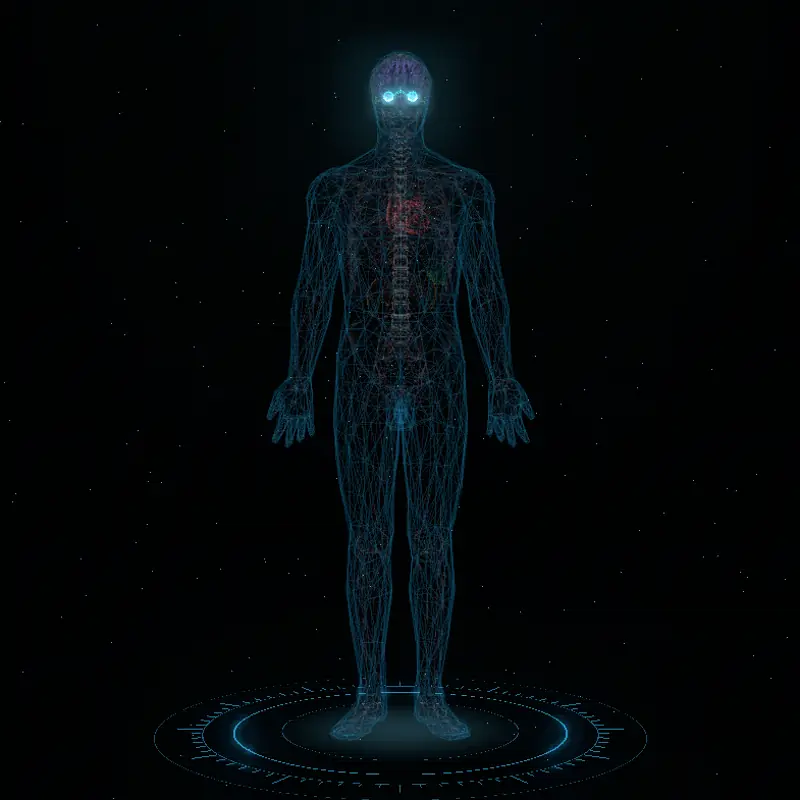
Holographic 3D human anatomy model from the interactive body map Explore the 3D body › Model: BodyParts3D, CC BY 4.0

The short version

On Earth, gravity pulls blood and other fluids toward the feet and loads our bones and muscles every time we stand. In orbit, that pull is gone (crews are in continuous free fall, called microgravity). The body adapts quickly, sometimes too well:

  • First days: fluid moves toward the head, and the balance system is confused. Motion sickness affects up to 73% of crewmembers in the first 2–3 days [3].
  • Weeks to months: bones and muscles that no longer carry weight start to weaken. Hip and spine bone density historically fell about 1–1.5% per month; with current resistance exercise, average losses are about 0.3–0.8% per month, varying widely [9]. On long missions, many crew develop eye changes, kidney stone risk rises, and radiation dose builds up.
  • Back on Earth: the adaptations reverse. Crews feel light-headed and unsteady at first; most systems recover in weeks, but bone can take more than a year [10].

Crews fight back with daily exercise, careful nutrition, medicines and medical checks. Their flight surgeon (the physician responsible for crew health) watches from the ground. To see how that looks, try the crew health command center.

In depth: plain-English explainers

Longer, fully cited guides to single body systems: what changes and why, a timeline from the first days to a Mars-length mission, what crews do about it, recovery after landing, and what it means for clinicians. Reviewed Oct 20, 2026 (AI-assisted clinical and source review; no named human clinician)

Mission timeline: which effects appear when

Day 1: Fluid moves toward the head; puffy face, stuffy nose and headache; motion sickness can start; the spine lengthens and the back may ache; sleep is short from the first night.

Figures for each stage are cited in the system sections below. For mission phases and risks, see the mission timeline explorer.

System by system

Fluid shift: face and head

Day 1Week 1

What happens
Without gravity pulling fluid toward the feet, it moves up toward the chest and head[5]. The face swells, the nose gets stuffy and headaches are common in the first days[3][4].
When
Within hours. The body adapts in under 2 days by lowering circulating fluid volume[5].
How big
Headaches are reported by up to 90% of astronauts in the first few days[3]. Circulating (blood vessel) fluid volume drops by around 15% within about 2 days[5].
What crews do
Mostly time and simple remedies for congestion and headache. The same shift is thought to play a part in eye changes (SANS, below)[1].
After landing
The shift reverses on landing, which is why standing up can then cause light-headedness (see heart and blood vessels)[5].

Eyes (SANS)

6 months1 yearBack on Earth

What happens
Spaceflight associated neuro-ocular syndrome (SANS) is a set of eye changes on long missions: swelling where the optic nerve enters the eye, flattening of the back of the eyeball, folds in the retina and a shift toward farsightedness[1].
When
Weeks to months into long missions; signs are looked for throughout flight[1].
How big
About 70% of long-duration crew show at least one sign, and about 18% are diagnosed with clinically concerning SANS[1]. Separately, in postflight questionnaires about 29% of short-mission and 60% of long-mission astronauts reported blurrier near or distant vision; that is a symptom report, not a SANS diagnosis[2].
What crews do
Eye checks before, during and after flight, and glasses of increasing strength carried on board. There is no proven preventive treatment yet[1].
After landing
Vision so far has been correctable to 20/20 or better with updated glasses[1]. Flattening of the eyeball has persisted more than 7 years after flight in some crew[1].

Brain, balance and motion sickness

Day 1Week 1Back on Earth

What happens
The inner ear’s balance organs stop sensing "down", and the brain receives conflicting signals. The result is space motion sickness (space adaptation sickness): nausea, vomiting, headache and disorientation[3].
When
First hours to days. Symptoms usually resolve within about 72 hours as the brain adapts[3].
How big
NASA’s medical brief gives up to 73% of crewmembers during the first 2–3 days of spaceflight, and 70–90% overall[3]. Another NASA brief gives 50–70%[4].
What crews do
Anti-nausea medicines such as promethazine, tested on the ground before flight, and no spacewalks scheduled in the first 72 hours[3].
After landing
Dizziness and unsteadiness return after landing while the brain readjusts to gravity[3]. After long missions, time to complete an obstacle course rose a median 48% after landing and recovered to about 95% of baseline in about 15 days[28].

Heart, blood vessels and fainting on standing

Week 1Back on Earth

What happens
With less fluid in the circulation and no gravity to work against, the cardiovascular system adapts to an easier job[5]. Slow or reversed blood flow in the neck (jugular) veins, and rarely a clot, has been found in flight[7].
When
Days in flight; the main problem shows up on return to gravity[5].
How big
Returning crew have 12–15% less blood volume and 10–12% fewer red blood cells than normal[8]. Fainting on standing (orthostatic intolerance) is more common after long missions than short ones[6].
What crews do
Exercise in flight, drinking salt water before re-entry, compression garments on the legs[5], and medical help with standing and walking after landing[8].
After landing
Fluid loading and leg compression help on landing day while the body readapts to gravity[5][8].

Bones

Month 16 months1 yearBack on Earth

What happens
Bones that normally carry body weight, such as the hip and spine, lose mineral when they are no longer loaded[9].
When
Starts in the first weeks and continues for the whole mission[9].
How big
Historically about 1–1.5% of hip and spine mineral density per month (Mir cosmonauts, before today’s exercise equipment). With current heavy resistance exercise on the station, average losses are smaller, about 0.3–0.8% per month, but vary widely between crewmembers. Even at those rates, monthly loss is faster than older adults lose in a year[9].
What crews do
Heavy resistance exercise on the station’s Advanced Resistive Exercise Device, plus vitamin D and enough food energy[11][27]. Crew who kept vitamin D levels up, ate enough to hold body weight and used the device maintained bone density[27].
After landing
Slow and sometimes incomplete: 9 of 17 astronauts had not recovered shin-bone (tibia) density a year after flight[10].

Muscles and fitness

Month 16 monthsBack on Earth

What happens
Muscles that hold us upright against gravity, especially in the calves and back, shrink and weaken, and aerobic fitness falls[14].
When
Within weeks; the largest drop in aerobic fitness comes early in flight[12].
How big
Peak aerobic fitness fell about 17% early in station flights[12]. In 4 crew on 6-month missions in the early station years (before today’s heavier resistance machine), calf muscle volume fell 10–16% and thigh 4–7%[13]. Many long-duration crew return with more than 10–20% loss of aerobic capacity and muscle strength[14].
What crews do
Daily aerobic and resistance exercise. NASA requires crews to keep aerobic capacity and strength at or above 80% of preflight values[15].
After landing
Aerobic fitness was still low 10 days after landing and recovered by about 30 days[12]. NASA requires an individual reconditioning program for every crewmember after landing[15].

Kidneys and kidney stones

Month 16 monthsBack on Earth

What happens
Calcium released from bone ends up in the urine, and crews make less urine, so stone-forming salts become more concentrated[16].
When
Urine chemistry favours stones during and just after flight[16].
How big
In long-duration crew, urine volume was 47% lower early (before flight day 30) and 39% lower after day 60[16]. One modelling review estimated that stone rates in the year after flight may approach 2–7 times preflight rates, with wide uncertainty[16].
What crews do
Drinking more water: a model suggests in-flight intake of about 3.2 liters a day would bring stone risk back to preflight levels, or about 2.5–2.7 liters a day if urine calcium is also lowered. This is a prevention target for flight, not advice for treating a stone. Crews also limit salt, and selected crew take potassium citrate[16].
After landing
Urine chemistry returns toward normal after landing. Long-term NASA data show many stones occur years after flight, so how long the risk lasts is not settled[16].

Immune system

Month 16 months

What happens
The immune system shifts in flight, and viruses that normally lie dormant in the body can become active again[17][18].
When
Changes persist through 6-month missions[17].
How big
In 23 astronauts on long station flights, all but one shed at least one dormant herpes virus (Epstein-Barr, varicella-zoster or cytomegalovirus) at some point before, during or after flight, compared with 2 of 20 people on the ground[18].
What crews do
A pre-launch health stabilization program reduces the chance of catching an infection before launch[34].
After landing
Studies so far follow crew mainly during flight; the long-term picture is still being studied[17].

Skin

Month 16 months

What happens
Rashes and skin irritation are common, and the skin’s community of microbes changes in flight[19][20].
When
Throughout long missions[19].
How big
In medical records from 46 long-duration crewmembers, skin rash was the most often reported clinical event (1.12 events per flight year), and rashes or hypersensitivity made up 40% of the more notable events[19].
What crews do
Treatment from the onboard medical kit; NASA’s radiation limits also cap skin dose[15].
After landing
Most rashes are mild, but some last a long time or do not respond to the creams on board. Rashes made up 40% of the notable (prolonged or treatment-resistant) events[19], and skin rash was the only condition with reported medicine failures in a station medication study[22][35].

Sleep and body clock

Day 1Week 16 months

What happens
The station circles Earth about every 90 minutes, so crews pass through 16 sunrises and sunsets a day[24]. Noise, workload and schedule shifts make sleep short[23].
When
From the first night[23].
How big
Crew slept about 6 hours a night on average (5.96 hours on shuttle missions, 6.09 hours on the station)[23]. Sleep medicines were the most used drug class on the station: 71% of crewmembers reported using them[22][35].
What crews do
Planned sleep schedules, lighting and private crew quarters, with sleep medicines available[23][21].
After landing
Sleep improved in the first week back on Earth[23].

Behavioral health and isolation

6 months1 yearMars-class

What happens
Confinement, distance from family, workload and risk can lead to stress, low mood, anxiety and friction between crewmembers[21].
When
Can appear at any point; the risk grows with mission length and distance[21].
How big
2 of 7 NASA Shuttle–Mir astronauts reported depressive symptoms[21].
What crews do
Psychological selection and training, private conferences with the flight surgeon and psychologist, and attention to schedules and lighting[21].
After landing
Behavioral health support is provided before, during and after the mission[21].

Radiation

6 months1 yearMars-class

What happens
Above the atmosphere, crews are exposed to cosmic rays and bursts of particles from the Sun. In low orbit, Earth’s magnetic field still deflects much of this; beyond it, on the way to the Moon or Mars, exposure is higher[33]. The main concern is a higher long-term risk of cancer[15].
When
Dose adds up every day in space[30].
How big
NASA limits each astronaut’s career dose to below 600 millisieverts (mSv)[15]. NASA estimates about 21 mSv for a short low-orbit mission (under 30 days), about 250 mSv for a long one (up to a year), and about 1,400 mSv for a full Mars mission of about 2–3 years including time on the surface, more than twice the career limit[33]. A 2013 measurement inside a robotic spacecraft on its way to Mars suggested the shortest round trip alone would give about 0.66 ± 0.12 sievert[29]. Shielding reduces the cosmic-ray dose only modestly: about 7% on average in a NASA design brief[30], up to about 15% with good vehicle design in the NASA standard[15].
What crews do
Radiation monitoring, shelters against solar storms, and limiting time in space[30].
After landing
Radiation dose does not "recover"; it adds to lifetime risk, which is why limits are set per career[15].

Spine height and back pain

Day 1Week 1Back on Earth

What happens
Without gravity compressing the discs between the vertebrae, the spine lengthens, and many astronauts get back pain early in flight[8][25].
When
First days of flight[25].
How big
The spine lengthens by about 6%[8]; overall height rises by about 3% over the first 3 to 4 days (roughly 5 cm in a 180 cm adult), almost all of it from the spine, and returns to normal soon after landing[36]. Back pain affected 52% of 728 astronauts, mostly mildly; curling into a fetal position helped 91%[25].
What crews do
Fetal positioning, pain relievers and exercise[25].
After landing
Astronauts have a higher rate of herniated (slipped) spinal discs than comparable people on Earth, so the back is watched after flight[26].

Gut and nutrition

Month 16 months1 yearMars-class

What happens
Appetite often falls, and crews tend to eat less than they need. The gut’s microbes also change[27][20].
When
Throughout flight[27].
How big
On earlier station expeditions, crews ate around 80% of recommended calories, with an average weight loss of 5%[27]. Vitamin D is the only supplement given to all crewmembers[27].
What crews do
A varied packaged menu, tracked intake, vitamin D, and enough calories to hold body weight, which also protects bone[27].
After landing
Nutrient levels return with a normal diet. For Mars, NASA notes its packaged foods last about 2–3 years, short of the 5 years a Mars mission would need[27].

Back on Earth

Back on Earth

What happens
Landing reverses the adaptations at once. Crews return with less blood volume, weaker postural muscles, lower bone density, a longer spine and a balance system tuned to weightlessness[8].
When
Landing day and the weeks after[8].
How big
12–15% less blood volume, 15–20% lower aerobic fitness and about 6% longer spine at landing[8]. Performance on an obstacle-course walking test recovered to about 95% of preflight in about 15 days after long missions[28]; aerobic fitness by about 30 days[12].
What crews do
Medical support at landing, including help with standing and walking, then an individual reconditioning program that starts as crew leave the vehicle[8][15].
After landing
Most systems recover in weeks to months. Bone can take longer than a year[10], the timing of kidney stone risk after flight is uncertain[16], and some eye changes persist[1].

Short mission vs long mission vs Mars

 Short mission (days)Long mission (station)Mars-class
Typical lengthDays to about 2 weeksAbout 6 months to a year on a space stationYears, most of it far from Earth
Main early effectsMotion sickness, fluid shift, back pain, short sleep[3][25][23]The same in the first days, then adaptationThe same, with no option to come home early
Bone and muscleLittle time for measurable lossBone historically about 1–1.5% per month, about 0.3–0.8% with current exercise (varies widely); aerobic fitness down about 17% early[9][12]Longer exposure; heavy exercise equipment must fit a small vehicle
Eyes (SANS)SANS is a long-mission finding. About 29% reported blurrier vision in a postflight questionnaire (a symptom, not a diagnosis)[2]About 70% show at least one sign[1]Unknown over years; no proven prevention yet[1]
RadiationAbout 21 mSv per mission (under 30 days in low orbit)[33]Up to about 250 mSv per mission (up to a year in low orbit); counts toward the 600 mSv career limit[33][15]About 1,400 mSv for a full mission, more than twice the limit[33]
Medical helpGround support in real time; return to Earth within about a day (NASA planning assumption for low orbit)[33]Real-time ground support; evacuation within about a day[33]Messages up to about 22 minutes each way and blackouts of weeks; no evacuation[31][33]
Recovery after landingDaysWeeks to months; bone can take more than a year[10]Unknown; landing on Mars without a recovery team adds risk

Signal delay to Mars: try the signal delay calculator, or supervise a simulated care robot in the ground flight surgeon live console.

Spaceflight participants vs career astronauts

Career astronauts are selected and monitored against NASA medical standards, train for years and fly long missions with daily exercise programs [15]. Spaceflight participants (paying or sponsored private flyers) usually fly short missions. In the U.S., operators must tell them in writing about the known and unknown risks and train them for emergencies, but federal rules set no medical standards for them [32].

On orbital flights, participants face the same early effects as astronauts: motion sickness, congestion, headache, back pain and fluid shifts, then light-headedness and unsteadiness at landing [4]. In the 3-day Inspiration4 civilian mission, almost all measured changes were back to baseline after return [37]. Long stays on future commercial stations would bring the long-mission effects above.

For clinicians: commercial spaceflight participant screening, the screening checklist and the learning path for the public and participants.

Frequently asked questions

What happens to the human body in space?

Without gravity, body fluids shift toward the head, the balance system is confused (causing motion sickness in most first-time flyers for 2–3 days), and bones and muscles that normally carry weight start to weaken. Hip and spine bone density historically fell about 1–1.5% per month; with current resistance exercise, average losses are about 0.3–0.8% per month, varying widely. Long missions can also change the eyes, raise kidney stone risk and add radiation dose. Most changes reverse after landing, some slowly.[5][3][9]

Do astronauts get taller in space?

Yes, for a while. Without gravity squeezing the discs between the vertebrae, the spine lengthens by about 6% and overall height rises by about 3% over the first 3 to 4 days (roughly 5 cm in a 180 cm adult). Height returns to normal soon after landing. Many astronauts also get back pain in the first days of flight.[8][36][25]

What happens to astronauts when they return to Earth?

They land with about 12–15% less blood volume, lower aerobic fitness, weaker postural muscles and a balance system still tuned to weightlessness, so standing and walking can be hard at first. Performance on an obstacle-course walking test recovered to about 95% of preflight in about 15 days after long missions, and aerobic fitness by about 30 days.[8][28][12]

Do astronauts lose bone density, and does it recover?

Yes. Weight-bearing bone at the hip and spine historically lost about 1–1.5% of its mineral density per month in space; with today’s heavy resistance exercise, average losses are about 0.3–0.8% per month, varying widely between crewmembers. Heavy resistance exercise, vitamin D and enough food protect most of it, but recovery after landing is slow: 9 of 17 astronauts had not recovered shin-bone density a year after flight.[9][27][10]

Can astronauts wear glasses? Do their eyes change?

Yes. On long missions about 70% of crew show at least one sign of spaceflight associated neuro-ocular syndrome (SANS), and vision often shifts toward farsightedness, so glasses of increasing strength are carried on board. So far vision has been correctable to 20/20 or better with updated glasses.[1]

Is radiation in space dangerous for astronauts?

The main concern is a higher long-term cancer risk. NASA limits each astronaut’s career dose to below 600 millisieverts. Cosmic rays are hard to shield, so mission length matters most; NASA estimates a full Mars mission of about 2–3 years at about 1,400 millisieverts, more than twice the limit.[15][30][33]

What health problems do astronauts have in space?

Most in-flight problems are minor: motion sickness, stuffy nose and headache, back pain, short sleep and skin rashes. The bigger concerns for long missions are bone and muscle loss, eye changes (SANS), kidney stones, immune changes and radiation.[4][19][23]

Go deeper

How this page was checked

Written with AI assistance on Oct 20, 2026. Most figures are reused from pages on this site whose sources were already checked. New figures were checked the same day against the source: journal abstracts in PubMed (sleep, back pain, microbiome, Mars radiation), and the NASA documents themselves (landing medical support, eye changes, fluid shifts, food and nutrition, station facts). Figures that could not be verified were left out.

Later on Oct 20, 2026, the Medical Research Assistant (an AI research assistant, not a person) completed an AI-assisted clinical and source review. It opened all 33 sources and sent 12 required and 4 optional corrections. Each correction’s source was re-opened and checked before it was applied; all 16 were applied the same day (see Corrections below). No named human clinician has reviewed this page. Corrections: [email protected].

Corrections

Oct 20, 2026: changes from the AI-assisted clinical and source review

  • Bone loss: the 1–1.5% per month figure comes from Mir cosmonauts before today’s exercise equipment. The page now gives both that historical rate and the smaller average with current resistance exercise (about 0.3–0.8% per month, varying widely). This figure was corrected across the whole site.
  • Radiation: added NASA’s per-mission estimates (about 21 mSv for short and 250 mSv for long low-orbit missions; about 1,400 mSv for a full Mars mission). The 2013 cruise-only measurement (0.66 ± 0.12 sievert) is no longer compared directly with the career limit. Replaced “small dose” with a number, and credited Earth’s magnetic field, not only the atmosphere.
  • Kidney stones: no longer says risk “stays raised for a year”; the 2–7 times estimate is now described as an uncertain modelling result, and the 3.2 liters a day figure as a modelled prevention target for flight, not advice for treating a stone.
  • Wording made to match the sources: rashes (some are prolonged or resistant to treatment), the walking test after landing, height (up to about 3%) as well as spine length (about 6%), and the short-mission eye figure (a symptom survey, not SANS).
  • Removed “lying down after landing”, which the cited sources do not support.
  • Newly sourced: time to return from low orbit (about a day, a NASA planning assumption), the pre-launch health stabilization program, the 71% sleep-medicine figure, a second NASA motion sickness range (50–70%), and a second shielding figure (up to about 15%).
Sources (37)
  1. NASA OCHMO. Spaceflight Associated Neuro-ocular Syndrome (SANS). Medical Technical Brief OCHMO-MTB-001 (2024).
  2. Mader TH, Gibson CR, Pass AF, et al. Optic disc edema, globe flattening, choroidal folds, and hyperopic shifts observed in astronauts after long-duration space flight. Ophthalmology. 2011;118(10):2058–2069. PMID 21849212.
  3. NASA OCHMO. Space Adaptation Sickness (SAS). Medical Technical Brief OCHMO-MTB-004 (2025).
  4. NASA OCHMO. Spaceflight Experience and Medical Care. Technical Brief OCHMO-TB-033.
  5. NASA OCHMO. Orthostatic Intolerance. Technical Brief OCHMO-TB-019.
  6. Lee SMC, Feiveson AH, Stein S, Stenger MB, Platts SH. Orthostatic intolerance after ISS and Space Shuttle missions. Aerosp Med Hum Perform. 2015;86(12 Suppl):A54–A67.
  7. Marshall-Goebel K, Laurie SS, Alferova IV, et al. Assessment of jugular venous blood flow stasis and thrombosis during spaceflight. JAMA Netw Open. 2019;2(11):e1915011.
  8. NASA OCHMO. Crew Medical Support for Entry, Descent, and Landing. Technical Brief OCHMO-TB-051 (2026).
  9. NASA Human Research Program. Evidence Report: Risk of Bone Fracture due to Spaceflight-induced Changes to Bone (approved for public release July 18, 2024).
  10. Gabel L, Liphardt AM, Hulme PA, et al. Incomplete recovery of bone strength and trabecular microarchitecture at the distal tibia 1 year after return from long duration spaceflight. Sci Rep. 2022;12:9446.
  11. NASA OCHMO. Bone Loss. Medical Technical Brief OCHMO-MTB-013, Revision D (2026).
  12. Moore AD Jr, Downs ME, Lee SMC, Feiveson AH, Knudsen P, Ploutz-Snyder L. Peak exercise oxygen uptake during and following long-duration spaceflight. J Appl Physiol. 2014;117(3):231–238. PMID 24970852.
  13. Gopalakrishnan R, Genc KO, Rice AJ, et al. Muscle volume, strength, endurance, and exercise loads during 6-month missions in space. Aviat Space Environ Med. 2010;81(2):91–102. PMID 20131648.
  14. NASA Human Research Program. Evidence Report: Risk of Reduced Physical Performance Capabilities Due to Reduced Aerobic Capacity, and Risk of Impaired Performance Due to Reduced Muscle Mass, Strength and Endurance (approved for public release January 22, 2023).
  15. NASA OCHMO. NASA-STD-3001, Space Flight Human-System Standard, Volume 1: Crew Health, Revision C (2023).
  16. NASA Human Research Program. Evidence Report: Risk of Renal Stone Formation (approved for public release September 23, 2024).
  17. Crucian B, et al. Alterations in adaptive immunity persist during long-duration spaceflight. NPJ Microgravity. 2015;1:15013. PMID 28725716.
  18. Mehta SK, et al. Latent virus reactivation in astronauts on the International Space Station. NPJ Microgravity. 2017;3:11. PMID 28649633.
  19. Crucian B, et al. Incidence of clinical symptoms during long-duration orbital spaceflight. Int J Gen Med. 2016;9:383–391. PMID 27843335.
  20. Voorhies AA, Mark Ott C, Mehta S, et al. Study of the impact of long-duration space missions at the International Space Station on the astronaut microbiome. Sci Rep. 2019;9(1):9911. PMID 31289321.
  21. NASA OCHMO. Behavioral Health and Performance. Technical Brief OCHMO-TB-016.
  22. Wotring VE. Medication use by U.S. crewmembers on the International Space Station. FASEB J. 2015;29(11):4417–4423. PMID 26187345.
  23. Barger LK, Flynn-Evans EE, Kubey A, et al. Prevalence of sleep deficiency and use of hypnotic drugs in astronauts before, during, and after spaceflight: an observational study. Lancet Neurol. 2014;13(9):904–912. PMID 25127232.
  24. NASA. Space Station Facts and Figures.
  25. Kerstman EL, Scheuring RA, Barnes MG, DeKorse TB, Saile LG. Space adaptation back pain: a retrospective study. Aviat Space Environ Med. 2012;83(1):2–7. PMID 22272509.
  26. Johnston SL, Campbell MR, Scheuring R, Feiveson AH. Risk of herniated nucleus pulposus among U.S. astronauts. Aviat Space Environ Med. 2010;81(6):566–574. PMID 20540448.
  27. NASA Human Research Program. Evidence Report: Risk of Performance Decrement and Crew Illness Due to Inadequate Food and Nutrition (approved for public release April 9, 2024).
  28. Mulavara AP, Feiveson AH, Fiedler J, et al. Locomotor function after long-duration space flight: effects and motor learning during recovery. Exp Brain Res. 2010;202(3):649–659. PMID 20135100.
  29. Zeitlin C, Hassler DM, Cucinotta FA, et al. Measurements of energetic particle radiation in transit to Mars on the Mars Science Laboratory. Science. 2013;340(6136):1080–1084. PMID 23723233.
  30. NASA OCHMO. Design for Ionizing Radiation Protection. Technical Brief OCHMO-TB-020.
  31. NASA. Mars communications disruption and delay (fact sheet, 2023 Moon to Mars Architecture Concept Review).
  32. 14 CFR Part 460 — Human Space Flight Requirements (informed consent and training for spaceflight participants).
  33. NASA Human Research Program. Evidence Report: Risk of Radiation Carcinogenesis (2026). Table 3, Design Reference Mission categories.
  34. NASA OCHMO. Medical Operations. Technical Brief OCHMO-TB-044 (2025).
  35. NASA Office of the Chief Health and Medical Officer. Pharmaceutical Care. Medical Technical Brief OCHMO-MTB-012, Revision B (2026).
  36. NASA. What’s Your Space Height? (educator guide, 2018).
  37. Jones CW, Overbey EG, Lacombe J, et al. Molecular and physiological changes in the SpaceX Inspiration4 civilian crew. Nature. 2024;632(8027):1155–1164.

Search and quick actions

Type to search. Use the up and down arrow keys to move through results, Enter to open, Escape to close.